
Does AI recommend your brand? How to find out
If a customer asks ChatGPT for the best option in your category, are you in the answer? Here's a rigorous way to check — and to track it over time instead of guessing.
The buying journey now starts inside the model
'Best dental clinic in Istanbul.' 'Top data integration tools.' 'A reliable lawyer for a property dispute.' Buyers ask AI engines questions like these every single day, at the exact moment they're forming a shortlist. The brands the model names enter the consideration set; the brands it omits never get a chance to compete. For a growing share of customers, the first impression of your category isn't a Google results page — it's a paragraph written by ChatGPT.
So the question 'does AI recommend my brand?' is no longer academic. It's a direct measure of whether you're in the running for customers who research the way most people now do.
Two different things you're actually checking
When you check your AI visibility, you're really measuring two separate signals that people often conflate:
- Are you named? Does the model mention your brand by name in its answer — listing you among the options for the query?
- Are you cited? Does the model use your website as a source, with a citation link, when it builds the answer?
Why a single manual check will mislead you
The obvious approach is to open ChatGPT, ask your key question, and see if you appear. Do that and you'll draw the wrong conclusion almost every time. Generative answers are non-deterministic: ask the same question twice and you can get two different lists. Ask it on Perplexity instead of ChatGPT and the sources change entirely. Ask from a different country and the recommendations shift again.
One manual check is a single sample from a noisy distribution. It can show you a competitor and hide you, or flatter you with a mention you'd never get on the next run. Drawing a strategy from it is like judging your Google rankings by refreshing the page once.
What a rigorous measurement looks like
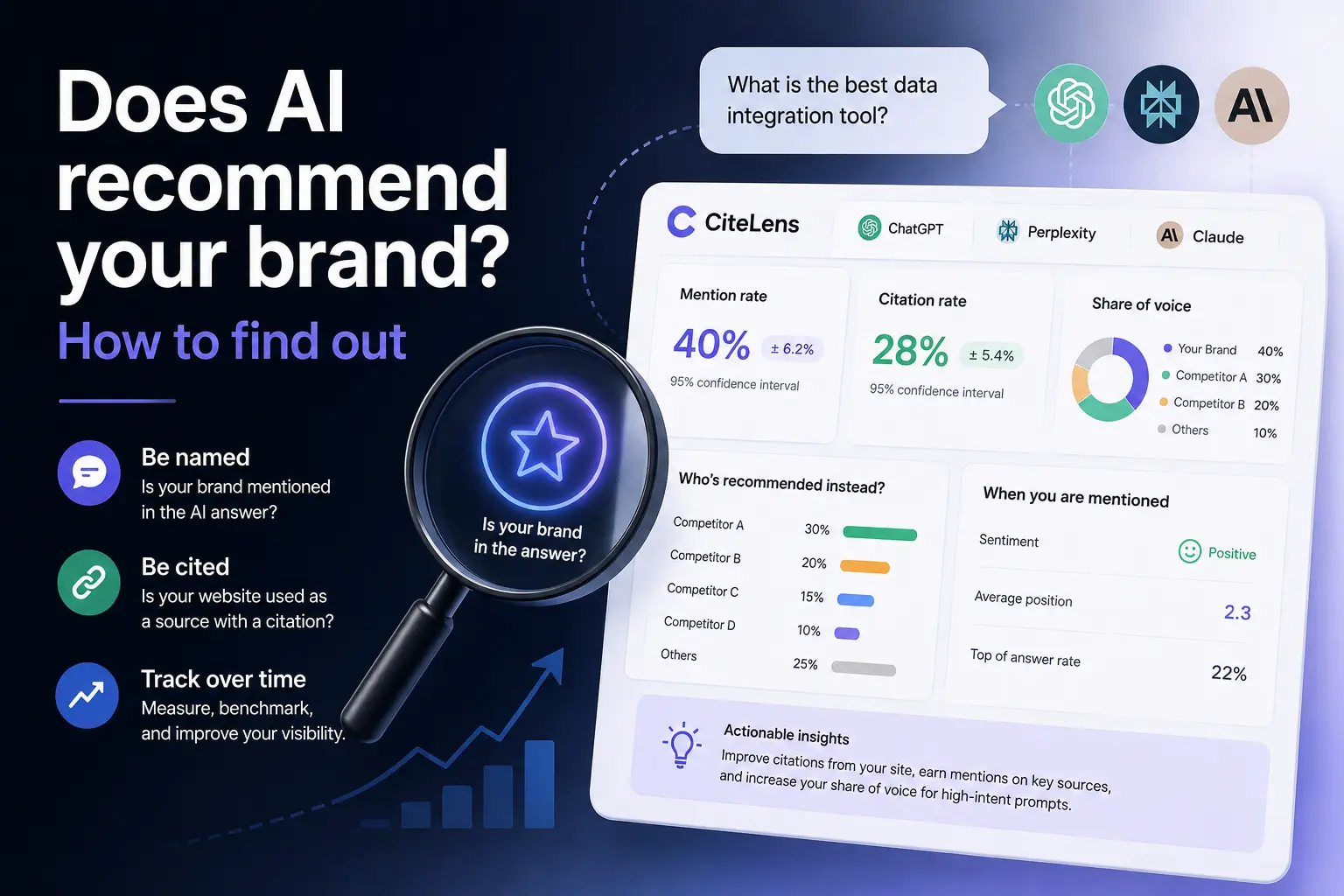
To get an honest read, you have to treat it like measurement, not anecdote. That means running each prompt many times, across multiple engines, and aggregating the results into rates with a confidence interval — so you can tell a real 40% mention rate from random noise. The metrics that actually matter:
- Mention rate and citation rate — how often, out of many runs, you're named and cited for each prompt.
- Share of voice — your visibility relative to the competitors that show up alongside you.
- Who's recommended instead — the specific brands winning the answers you're missing.
- Sentiment and position — when you are mentioned, are you described positively, and how early in the answer.
Turning the data into action
Measurement is only useful if it points to a move. A low citation rate with a healthy mention rate suggests your brand is known but your site isn't being pulled as a source — a content and crawlability problem. Strong competitor share of voice on a specific prompt points you to the exact sources you need to earn. Tracking the numbers over time tells you whether your GEO work is actually changing the answer or just keeping you busy.
This is precisely what CiteLens automates: it runs your prompts repeatedly across ChatGPT, Perplexity and Claude, reports your mention and citation rates with a 95% confidence interval, benchmarks you against the competitors stealing the answer, and recommends the concrete fixes that move you into it. Instead of guessing whether AI recommends you, you get a measured, trackable answer — and a plan to improve it.
Alper Tekin is the founder of CiteLens, a GEO and AI-visibility platform. He researches how AI engines like ChatGPT, Perplexity, Claude and Google's AI Overviews decide which brands to recommend and which sources to cite, and writes about generative engine optimization based on original data.