
Generative Search Optimization (GSO) vs GEO: are they the same?
GSO, GEO, AEO, LLM SEO — the labels are multiplying. Here's what generative search optimization actually means, how it relates to GEO, and what to do about it.
A category with too many names
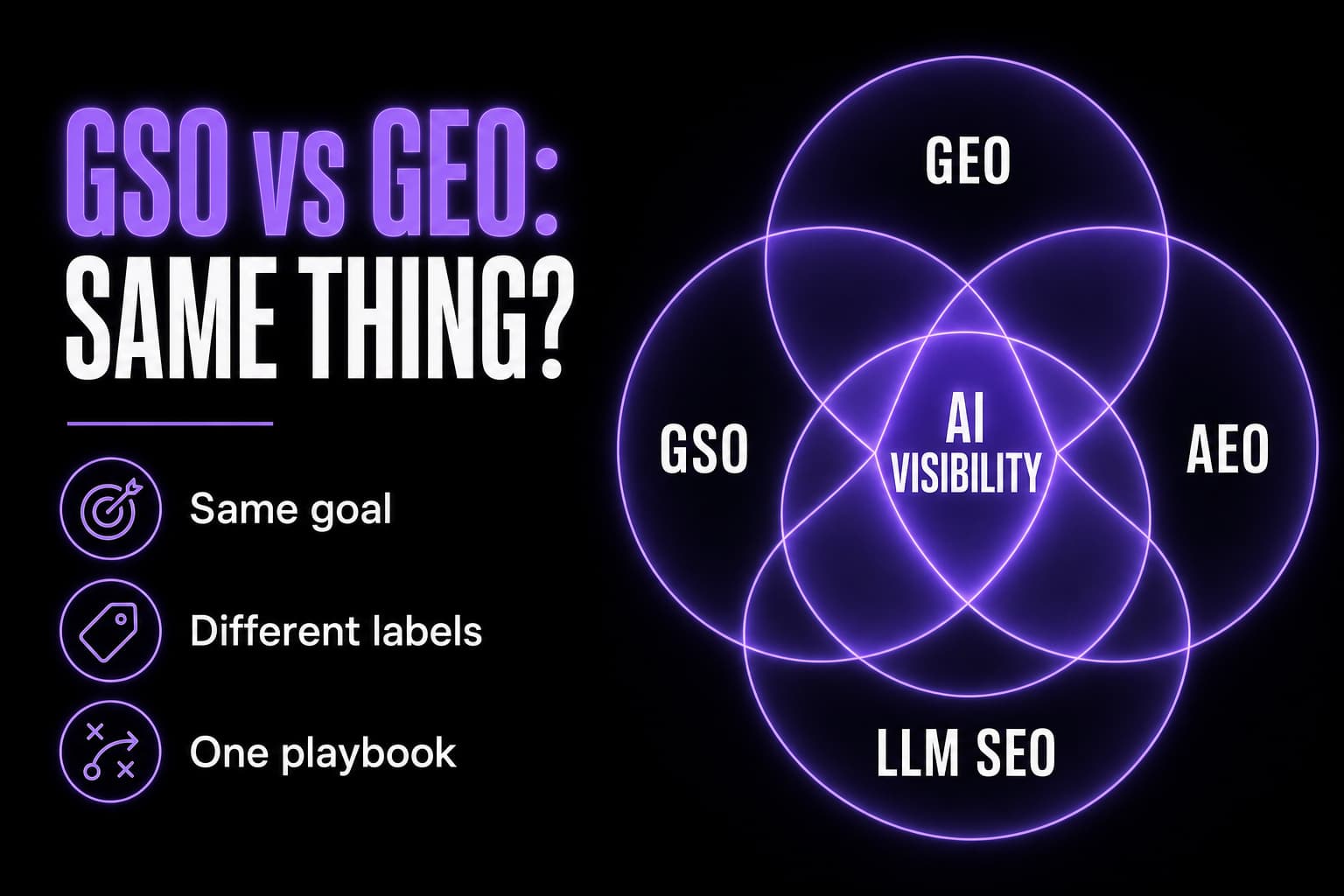
Generative Search Optimization (GSO), Generative Engine Optimization (GEO), Answer Engine Optimization (AEO), LLM SEO — these terms are all circling the same shift: search is moving from a list of links to a generated answer, and brands need to be visible inside that answer. The labels differ mostly by who coined them and which surface they emphasize, not by the underlying work.
If you're trying to decide which term to 'do', that's the wrong question. They describe the same goal: being named and cited by AI systems when they answer your customers' questions. Pick the vocabulary your team understands and focus on the work, which is the same across all of them.
Where the terms do differ
There are subtle emphases worth knowing:
- GEO (Generative Engine Optimization) — the broadest and most common term; optimizing for any generative engine, including ChatGPT, Perplexity, Claude and AI search.
- GSO (Generative Search Optimization) — usually stresses the search-engine side: AI Overviews, AI-powered search results, the retrieval layer specifically.
- AEO (Answer Engine Optimization) — frames it around 'answer engines' and often overlaps with featured-snippet-style optimization.
- LLM SEO — emphasizes the model itself and how brands surface from training plus retrieval.
Why the distinction doesn't change your playbook
Whatever you call it, the levers are identical: make your content retrievable and quotable, earn mentions on the sources these systems trust, keep your site open to AI crawlers, and send clear entity signals about what you do. A page optimized for GEO is automatically optimized for GSO and AEO, because they all reward the same fundamentals. The terminology debate is mostly marketing; the work is one discipline.
The practical risk of the naming confusion is paralysis — teams waiting to pick the 'right' framework instead of starting. Don't. Begin by measuring where you stand inside AI answers, then improve it.
Start by measuring, whatever you call it
The honest test of any of these acronyms is the same: when your customers ask AI engines about your category, are you named, and are you cited? CiteLens measures exactly that across ChatGPT, Perplexity and Claude — your mention rate, citation rate and share of voice with a 95% confidence interval — so you can stop debating labels and start improving the number that matters.
Alper Tekin is the founder of CiteLens, a GEO and AI-visibility platform. He researches how AI engines like ChatGPT, Perplexity, Claude and Google's AI Overviews decide which brands to recommend and which sources to cite, and writes about generative engine optimization based on original data.