
How to audit your brand's AI visibility (and what to fix)
An AI-visibility audit answers a different question than an SEO audit: when buyers ask AI for a recommendation, do you show up? Here's the exact, repeatable process — and what to fix first.
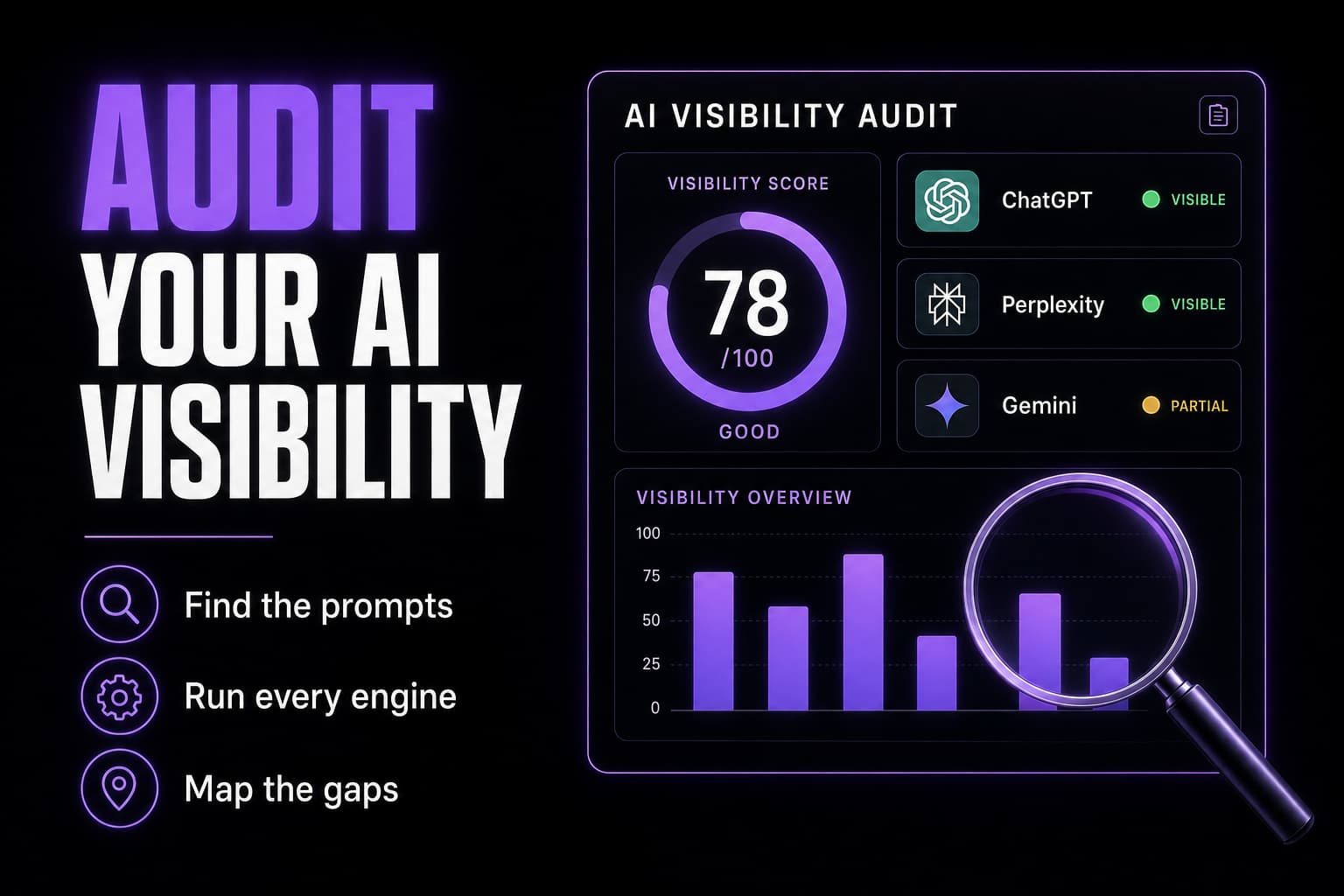
An AI-visibility audit isn't an SEO audit
An SEO audit asks “where do we rank in Google's blue links?” An AI-visibility audit asks a different and increasingly more important question: when someone asks ChatGPT, Perplexity, Gemini or Google's AI Overview for a recommendation in your category, do you show up — and how? The mechanics are different, the signals are different, and the tooling is different. Treating one like the other is the most common mistake brands make in 2026.
The good news: an AI-visibility audit follows a clear, repeatable process. Below is exactly how we run one — the same steps whether you do it yourself or have our team do it for you.
Step 1 — Start from prompts that matter, not keywords
Keywords are how people typed into a search box. Prompts are how people actually talk to AI: full questions, with context and constraints — “best 4-star hotel in Taksim for a family”, “affordable CRM for a small agency”, “reliable dentist near me that takes my insurance”. Your audit starts by collecting the real prompts your buyers ask, segmented by intent (informational, commercial, local) and by persona.
Miss this step and everything downstream is noise. The right prompt set is the difference between “we measured our visibility” and “we measured the visibility that actually drives revenue.”
Step 2 — Run every prompt across every engine, with repeats
AI answers are non-deterministic: ask the same question twice and you can get different brands. So a real audit doesn't ask once — it runs each prompt several times across each engine (ChatGPT, Perplexity, Claude, Gemini, Google AI Overviews) and aggregates. That's the only way to separate a real trend from a lucky roll.
Location and language matter enormously here. “Best hotel in Taksim” returns completely different answers in Türkiye vs the US, and in Turkish vs English. A credible audit pins the market and language to your actual audience.
Step 3 — Measure two signals, not one
There are two distinct ways to win in an AI answer, and they must be measured separately. The brand mention: does the AI write your name as a recommendation? The domain citation: does the AI link or attribute a claim to your website as a source? You can have one without the other — recommended by name while a third-party listicle gets cited, or cited as a source while never named as an option.
A good audit reports both, with a confidence interval, so you can tell a real 60% from a noisy 60% and know which lever to pull.
Step 4 — Map the gaps and the sources behind them
Once you know where you're absent, the audit asks why. Which competitors show up instead of you? Which domains does the AI pull from when it answers your prompts — and are you present on them? Often the single biggest lever is a high-influence source (a listing, a review site, an industry roundup) that cites your rivals but not you. This source map turns a vague “we're not visible” into a concrete, prioritized to-do list.
What to fix first
Audit results almost always cluster into a few high-leverage fixes:
- Crawlability — make sure AI bots (GPTBot, ClaudeBot, PerplexityBot) can reach and read your pages.
- Citability — restructure key pages to answer the prompt directly, in a quotable, self-contained way.
- Source presence — get onto and fully complete the high-influence listings and review profiles AI pulls from.
- Consensus — earn mentions on the third-party pages that shape how AI describes your category.
Do it yourself — or have us do it for you
You can run this whole process in CiteLens: add your brand and competitors, set your prompts, scan the engines, and read the gaps. Or, if you'd rather skip straight to the answers, our team runs the complete audit for you and hands you a branded report plus a live readout — that's the AI Visibility Audit.
Alper Tekin is the founder of CiteLens, a GEO and AI-visibility platform. He researches how AI engines like ChatGPT, Perplexity, Claude and Google's AI Overviews decide which brands to recommend and which sources to cite, and writes about generative engine optimization based on original data.