
How to rank on ChatGPT: a practical guide
There's no blue-link ranking inside ChatGPT — but there is a clear way to become the brand it names and the source it cites. Here's the practical playbook.
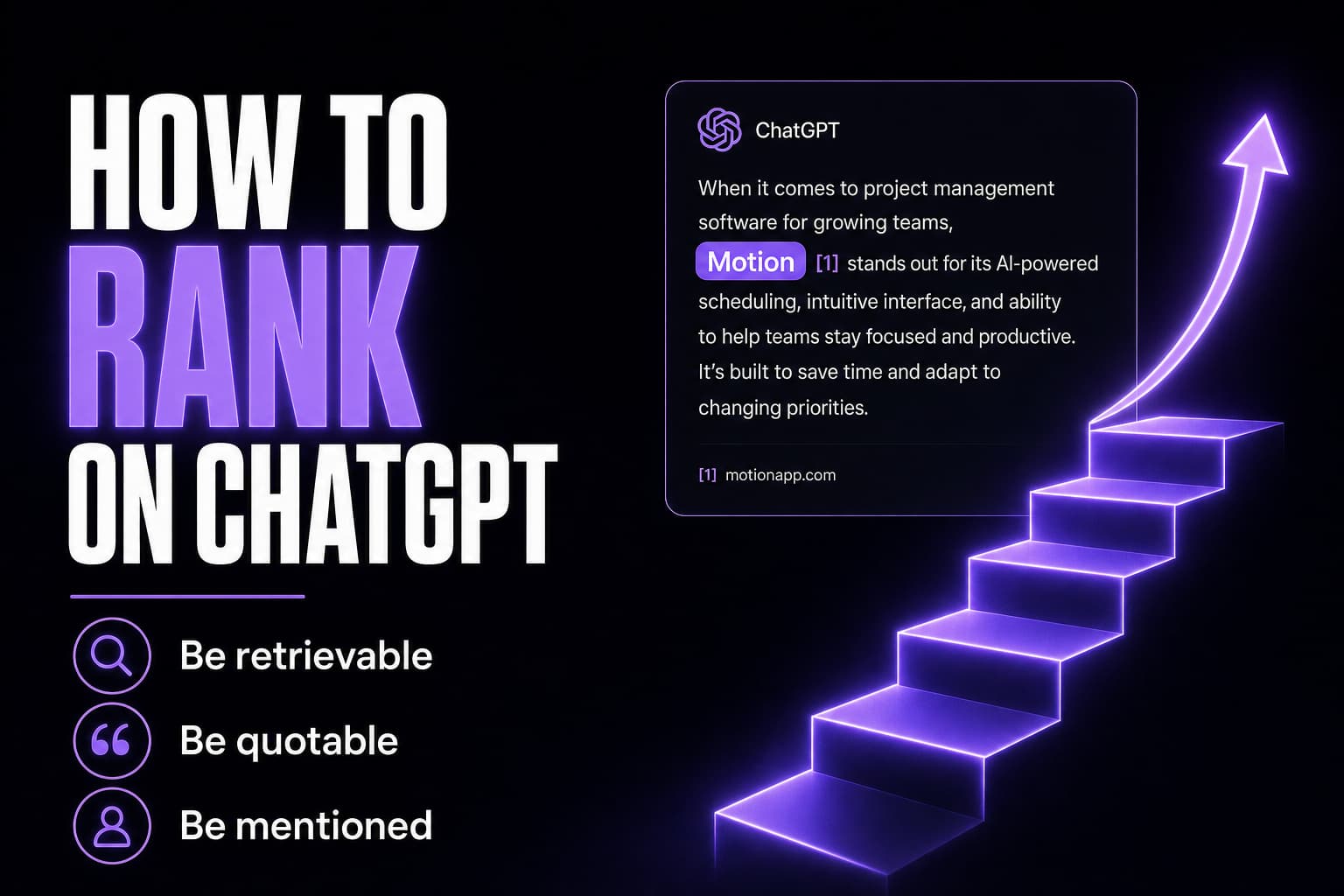
What 'ranking on ChatGPT' actually means
ChatGPT doesn't return a ranked list of ten links. It returns one synthesized answer, sometimes with a few citations attached. So 'ranking' here doesn't mean position #1 — it means two concrete things: being named in the answer, and being cited as a source. Optimizing for ChatGPT is the work of earning both, consistently, for the questions your customers ask.
That reframing matters, because the tactics that win a Google position aren't the same ones that get you into a generated answer. You're no longer competing for a slot on a page; you're competing to be the trustworthy, quotable thing the model reaches for when it writes its reply.
The three levers that decide whether you appear
Almost everything that affects your ChatGPT visibility comes down to three levers. Pull all three and you move; ignore any one and you stall.
- Be retrievable — when ChatGPT runs a web search mid-answer, your relevant page has to be in the candidate set. That requires content that matches real questions and a site AI crawlers (GPTBot, OAI-SearchBot) can actually fetch.
- Be quotable — the model grounds sentences in pages that state facts plainly. Clear headings, short factual paragraphs, definitions, comparisons and lists make your content easy to lift into an answer.
- Be mentioned elsewhere — the model trusts consensus. When the third-party sources it already reads (reviews, roundups, directories, reputable articles) name you, you become a safe, citeable choice — even before it touches your own site.
A step-by-step approach
Turn those levers into a repeatable process:
- Map the prompts — list the actual questions a buyer would type into ChatGPT in your category, not keywords. These are your targets.
- Audit visibility — for each prompt, check whether ChatGPT names you and cites you today, and who shows up instead. Do it across many runs, because answers vary.
- Fix retrievability — confirm AI bots aren't blocked, your key pages load fast and clean, and each page answers one question directly near the top.
- Make pages quotable — add a crisp one-sentence answer, structure with headings and lists, and include the facts a model would need to recommend you.
- Earn third-party mentions — get named on the sources ChatGPT already quotes for your topic; this is often the highest-leverage move.
- Re-measure — track mention and citation rate over time so you know what actually moved the answer.
Common mistakes that keep brands invisible
The most common failure isn't bad content — it's an AI-crawler block in robots.txt that quietly removes you from retrieval entirely. Close behind: burying the answer under marketing preamble so there's nothing quotable; relying only on your own site while competitors collect mentions on the sources the model trusts; and 'checking' ChatGPT once, seeing yourself, and assuming you're fine — when the next run omits you.
GEO is not a one-time fix. Models, prompts and the competitive set all shift, so visibility has to be monitored the way you'd monitor rankings.
Measure it instead of guessing
You can do everything above and still not know if it worked, because a single manual check is one noisy sample. CiteLens runs your prompts repeatedly across ChatGPT, Perplexity and Claude, reports your mention and citation rate with a 95% confidence interval, shows who's recommended instead of you, and turns the gaps into a concrete fix list — so ranking on ChatGPT becomes something you can manage, not guess at.
Alper Tekin is the founder of CiteLens, a GEO and AI-visibility platform. He researches how AI engines like ChatGPT, Perplexity, Claude and Google's AI Overviews decide which brands to recommend and which sources to cite, and writes about generative engine optimization based on original data.