
Zero-click search: how AI answers eat your traffic
More searches now end without a click. When the answer lives inside the AI response, visibility — not ranking — becomes the metric that decides whether you win the customer.
The click is quietly disappearing
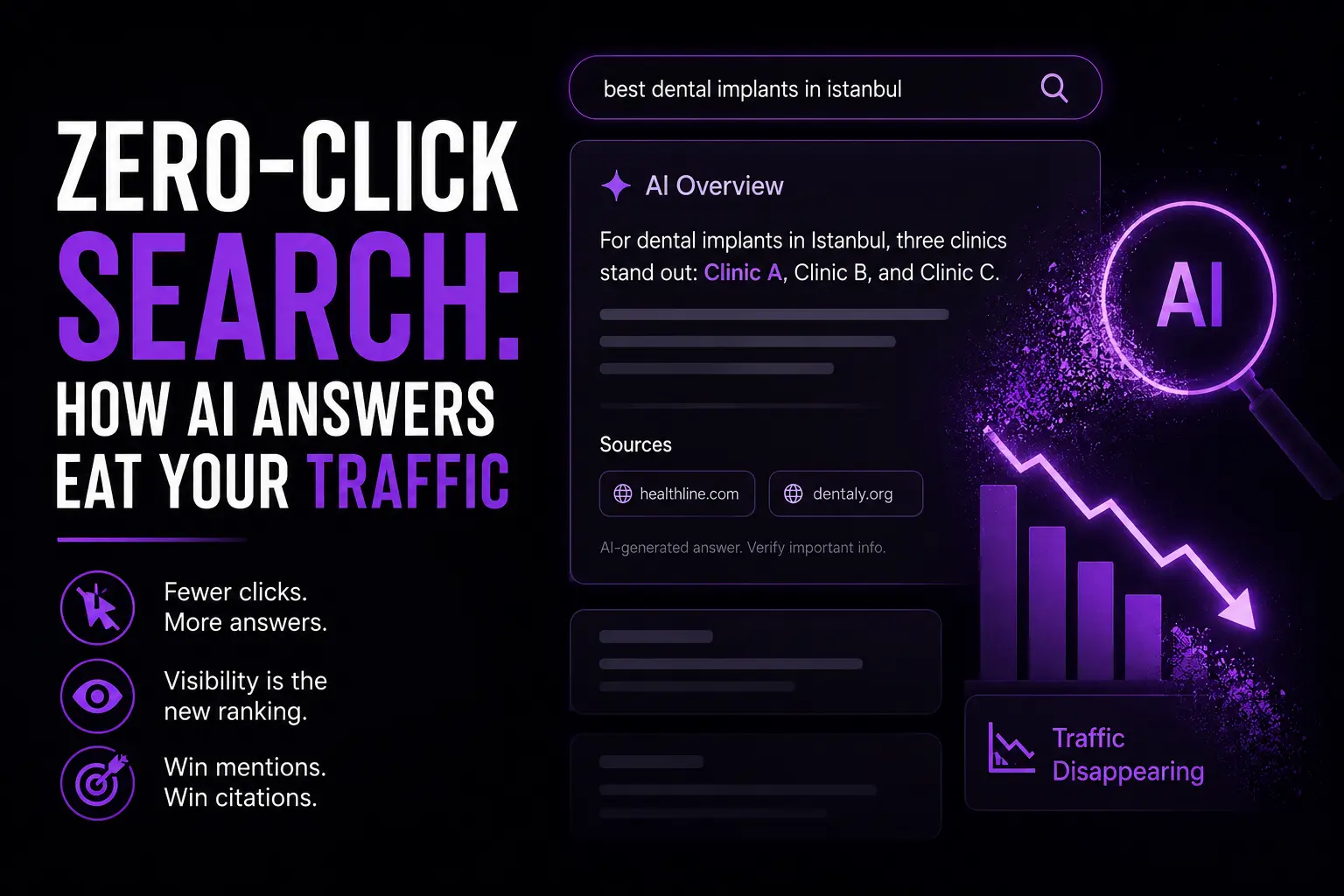
For two decades, the deal was simple: rank high, earn the click, get the visit. That deal is breaking. AI Overviews sit above the organic results and answer the question outright. ChatGPT and Perplexity resolve entire research tasks without sending the user anywhere. The result is the zero-click search — a query that's fully satisfied on the results surface itself, with no onward visit to any website.
This isn't a fringe behavior anymore. A large and growing share of informational and even commercial queries now end inside an answer. The user got what they needed; the websites that 'won' the ranking got nothing. For anyone whose business depends on being discovered through search, this is the single most important shift to understand.
Ranking #1 no longer guarantees the customer
Here's the trap: you can still be number one on Google and be completely absent from the AI answer the user actually reads. The blue-link ranking and the generated answer are two different competitions, judged on different criteria, and winning one tells you nothing about the other.
Classic SEO optimizes for position in a list. But if the list is collapsed into a paragraph that names three brands and cites two sources, the only positions that matter are: are you one of the brands named, and are you one of the sources cited? Everything else is invisible to the user. The battlefield moved from the ranking to the inside of the answer, and most teams are still measuring the wrong battlefield.
The two signals that now decide visibility
In the answer economy, there are exactly two ways to be present, and they're distinct:
- Brand mention — the AI names you in its prose. 'For implants in Istanbul, three clinics stand out: yours, and two others.' Being named puts you on the shortlist the buyer considers.
- Domain citation — the AI cites your website as a source. This drives the rare-but-valuable click and signals to the engine that your content is authoritative.
What this means for your strategy
The strategic shift is from ranking to visibility. Instead of asking 'where do I rank for this keyword', you ask 'how often does AI mention me, and cite me, for the questions my customers actually ask — and who gets recommended instead of me?' That reframing changes what you optimize for: you stop chasing positions on a list nobody sees and start earning a place in the answer everybody reads.
Concretely, that means publishing genuinely citeable content, keeping your site open to AI crawlers, and — crucially — earning brand mentions on the third-party sources these engines trust. A roundup, a review site or an industry directory that names you is often worth more in the AI era than a page-one ranking, because it's exactly what the model pulls from when it builds an answer.
You can't defend what you can't measure
The danger of zero-click is that it's invisible in your analytics. Traffic that never happens doesn't show up in Google Analytics; a recommendation you missed leaves no trace. You can watch your rankings hold steady while your share of the actual buying conversation quietly erodes.
That's why measuring AI visibility directly matters. You need to know your mention rate and citation rate across ChatGPT, Perplexity and Claude, your share of voice against competitors, and which sources to win to climb. Without that, zero-click search isn't just eating your traffic — it's eating it where you can't even see it happen.
Alper Tekin is the founder of CiteLens, a GEO and AI-visibility platform. He researches how AI engines like ChatGPT, Perplexity, Claude and Google's AI Overviews decide which brands to recommend and which sources to cite, and writes about generative engine optimization based on original data.